Why Property Tycoons Are Choosing Pakistan Over Dubai for Investment.
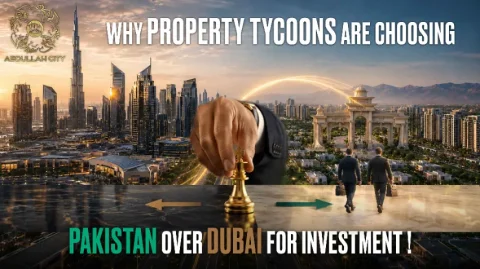
Ever wonder why the big players — the ones who could park their money anywhere in the world, Dubai, London, wherever — are quietly turning their attention back to Pakistan? It's not nostalgia. It's math. Over the last couple of years, real estate money has been shifting direction, and once you look at the numbers, the reasons become pretty obvious. Let's break it down without the usual sales pitch.
Dubai's Glow Is Still There, But It's Not the Same Sprint
Dubai has been the go-to for overseas investors for a reason — tax-free income, a luxury lifestyle, and the promise of sky-high returns. But 2026 isn't playing out quite as smoothly as the last few years did. Analysts are pointing out that Dubai has a massive wave of new units set to hit the market through 2026 and 2027 — somewhere in the range of 200,000 to 300,000 units by some estimates.
That kind of supply doesn't just disappear into demand overnight. Areas with heavy new handovers or a lot of speculative buying are already being flagged for a mild correction, and firms like Fitch have gone further, suggesting Dubai could see a "moderate correction" of up to 15% between late 2025 and 2026, following the roughly 60% price run up the city saw since 2022.
None of this means Dubai is crashing. It's not. But the days of "buy anything and watch it triple" are over, at least for now. Rental yields could soften in areas getting flooded with new stock, and entry costs are still steep — we're talking crores just to get in the door, plus service charges, plus the headache of currency conversion.
Islamabad and Rawalpindi: Slower, Steadier, and Actually Yours
Now flip to Islamabad's real estate scene. It's a completely different game. You can start small here — a middle-class family can get into an installment plan for a plot, and that same plot can appreciate meaningfully in three to five years if the location is right. Chakri Road is a good example of why.
It sits right on the M-2 Motorway, close to the New Islamabad International Airport, and has easy access to the Rawalpindi Ring Road. Whenever you get a location where a motorway, an airport, and a ring road all overlap, price appreciation tends to follow — that's just how these corridors have always worked, Chakri or otherwise.
That's exactly why property tycoons in Pakistan — from Lahore, Karachi, wherever — are putting capital back into the local market. The kind of money that buys one apartment in Dubai can build an entire portfolio of plots, or a decent commercial holding, back home.
How Pakistani Real Estate Tycoons Are Thinking Differently Now
Property tycoons in Pakistan have moved past the old "buy a plot and forget about it" approach. They're diversifying — residential, commercial, and farmhouse plots, often all at once. Real estate tycoons in Pakistan understand something simple: the moment the economy shows even a hint of stability, the twin cities' real estate market is usually the first thing to react, because demand here has consistently outpaced supply.
Abdullah City fits right into that pattern. It's on Chakri Road, developed by Aziz Builders, and the work is actually happening on the ground — boundary walls, roads, drainage, all visible in person. That's more than a lot of "paper only" housing schemes can say.
Now, Let's Be Honest About the Legal Side
If we're really talking human language here, one thing needs to be said plainly: Abdullah City have a final NOC issued by the RDA. The paperwork has been submitted and the process is reportedly at an advanced stage, but like a lot of projects along this belt, the final approval has been held up by a jurisdictional overlap between the RDA and the CDA.
What does work in the project's favor is that ownership is being transferred through proper registry and inteqal, meaning buyers can get their ownership formally recorded. That said, before putting money into any housing society — Abdullah City included — it's worth checking the RDA's official website yourself and verifying the current status. A smart investment is one made with your eyes open, not one made on a sales brochure.
So, Dubai or Islamabad?
Honestly, it's not really an either-or question — plenty of tycoons are doing both at once. But the trend is clear: Dubai's property market in 2026 is in more of a "wait and see" phase, while Islamabad's real estate is still in the earlier, faster-growth part of its curve — cheaper entry points, more room to run. Dubai residential property is still fantastic for lifestyle and luxury, no argument there.
But if you're looking for an investment closer to home — somewhere you can physically walk the land, verify the paperwork yourself, and get in early on a growing corridor — locations like Chakri Road, and developing societies like Abdullah City, are genuinely worth a closer look. Smart investors don't just chase a trend. They research it, verify it, and then decide. You should too.